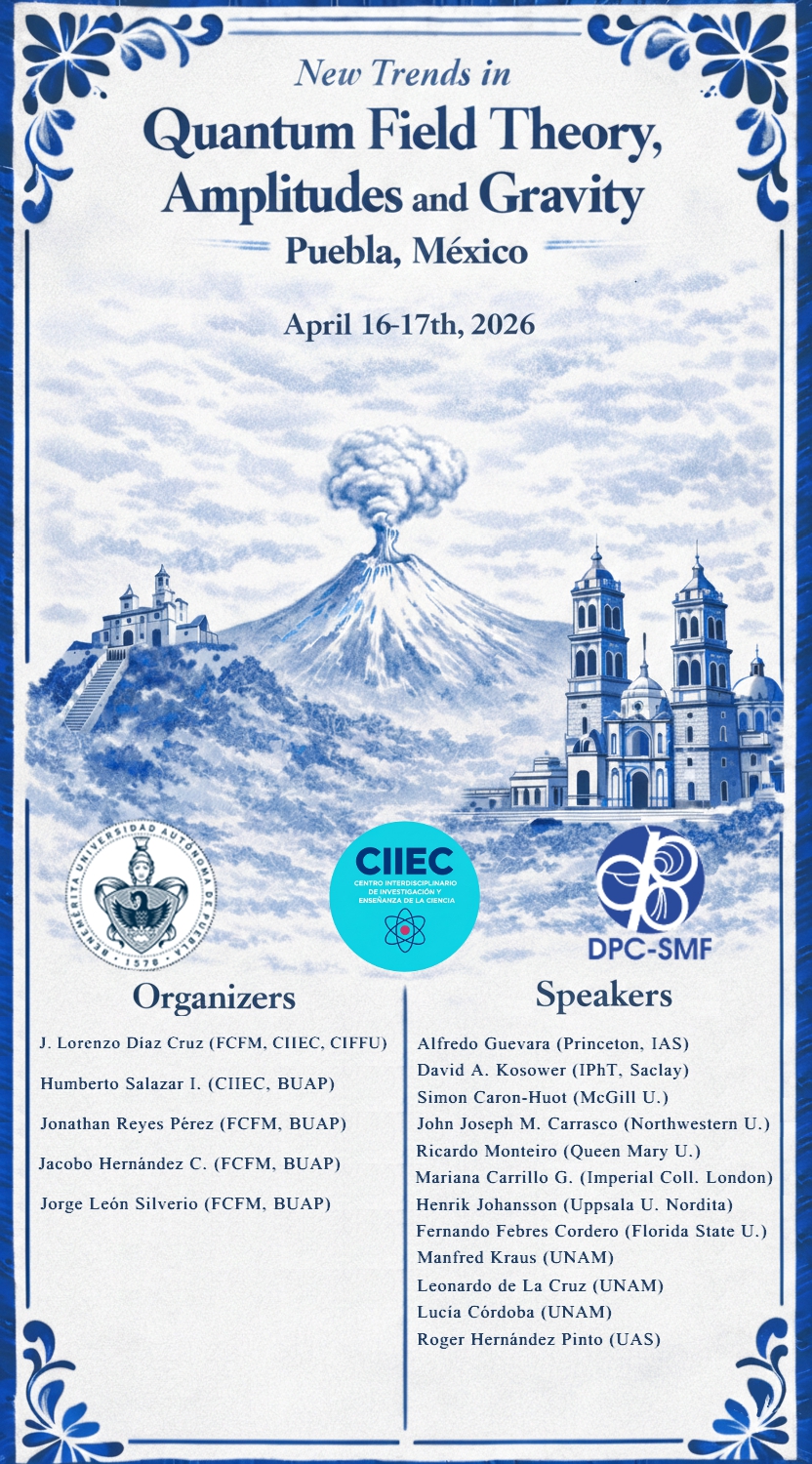
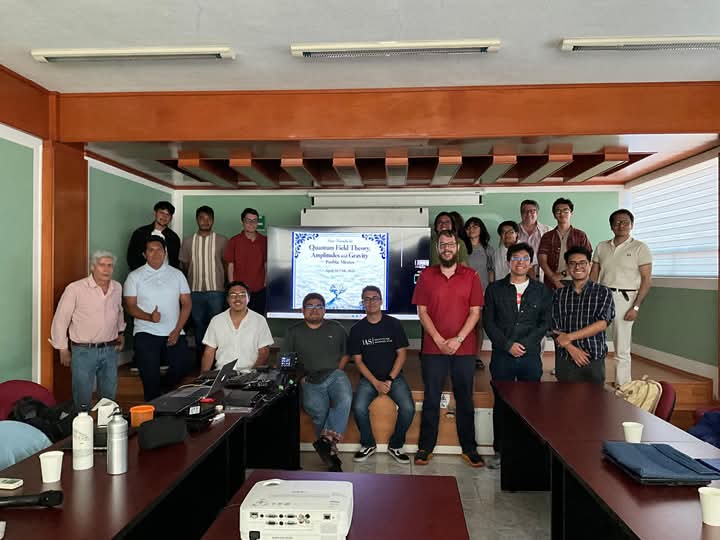
New Trends in Quantum Field Theory, Amplitudes and Gravity

America/Mexico_City
Centro Interdisciplinario de Investigación y Enseñanza de la Ciencia

Centro Interdisciplinario de Investigación y Enseñanza de la Ciencia

Humberto Salazar Ibargüen (CIIEC) , J. Lorenzo Díaz Cruz (FCFM, CIIEC, CIFFU) , Jonathan Reyes Pérez (BUAP)
Descripción


This event will bring together researchers working on recent developments in quantum field theory, scattering amplitudes, and gravity, with the aim of fostering discussion and collaboration across these closely related areas. One of the main goals of the meeting is to help the Latin American community gain broader exposure to current research directions in QFT and Amplitudes.


Participantes
  • Allan Alonzo Artiles
  • Avilez Ana
  • Bryan Larios
  • Carlos Javier Servin Tomas
  • Cristofer Nava
  • Diego Saldaña Ulloa
  • Enrique Ramirez Flores
  • Erick Rodrigo García Dávalos
  • Filippo Maria Bocciarelli
  • Gabriel Marin
  • Gerardo Hernández-Tomé
  • Jose Pablo Flores Saldaña
  • Julio Alberto Méndez-Zavaleta
  • Luis A. Huerta del Campo
  • Luis Alfredo Clemente Martínez
  • Manfred Kraus
  • Maria Conejero
  • Mario Aldair Pérez de León
  • Mario Espinosa Martínez
  • Martínez Valera Diego Armando
  • Miguel Ángel Estévez Juárez
  • Moctezuma Mata
  • Moises Zeleny
  • Olga Guadalupe Félix Beltrán
  • Oscar Meza Aldama
  • Rodrigo Aguilar Olivera
  • Rodrigo Pelayo Ramos
  • Saúl Guzmán Coca
    • 8:45 9:15
      Welcome: Opening words, Lorenzo Díaz Cruz and Humberto Salazar
    • 9:15 10:15
      David Kosower: Scattering Amplitudes for Gravitational Waves

      I give an overview of the application of scattering amplitudes to the computation of observables for gravitational waves.  I will focus on the KMOC approach.

    • 10:15 11:15
      Simon Caron-Huot: Causality constraints on effective theories of gravity

      According to relativity, it is not possible to send signals faster than light.  I will discuss constraints on effective theories which follow from general principles of relativity and quantum mechanics applied to 2 to 2 scattering processes.  I will introduce the method for scalar field theories, where it limits the possible patterns of higher-derivative corrections. I will then discuss theories of light spin-two particles, aka gravity, where modifications to Einstein's General Relativity will be tied to the mass scale of exotic higher-spin particles.

    • 11:15 11:45
      COFFEE BREAK
    • 11:45 12:45
      Mariana Carrillo: Double Copy in curved spacetimes

      The double copy relates gravitational theories to the "square" of Yang-Mills. In this talk, I will give a review of various double copy constructions and show how they arise in flat space and what progress has been made to get the similar relations in curved spacetimes.

    • 12:45 14:45
      Lunch
    • 14:45 15:45
      Fernando Febres Cordero: An Introduction to Numerical Techniques for Scattering Amplitudes

      We discuss modern technique for the computation of complex scattering amplitudes in QCD and in effective theory of gravity. We introduce the core concepts for numerical calculations within the Generalized Unitarity Method, more precisely describing the Multi-Loop Numerical Unitarity method. It will be accessible for undergraduate and graduate students with experience in computations of Feynman diagrams.

    • 15:45 16:45
      Roger Hernández Pinto: Mapping Causal Configurations via Graph-Theoretic Quantum Automation.

      This talk presents an automated quantum algorithm designed to optimize the identification of complex causal configurations, standing at the frontier of precision in high-energy physics. Utilizing a graph-theoretic approach, the method enables an efficient transition from acyclic structures to multiloop topologies, whose evaluation is critical for calculating scattering amplitudes with unprecedented levels of accuracy. The proposal offers a robust tool for processing information networks with non-trivial connectivity, systematically addressing the complexity of loops and their fundamental role in the causal structure of modern quantum field theories.

    • 16:45 17:45
      Lucía Córdova: Introduction to S-matrix Bootstrap

      In this talk I will give an introduction to the revived non-perturbative S-matrix program. I will review its core axioms—analyticity, unitarity, and crossing symmetry—and the modern methods used to implement them. I will also discuss several applications illustrating how this program can be used to carve out the space of consistent quantum field theories.

    • 17:45 18:45
      Leonardo de la Cruz: Fano and Reflexive Polytopes from Feynman Integrals
    • 9:00 10:00
      Henrik Johansson: Worldline Action for All-Spin Compton Scattering

      Worldline-QFT methods are used to compute tree-level gravitational Compton scattering to all orders in the spin expansion. After matching to classical Compton amplitudes, suggested to model effective Kerr interactions in the same-helicity and opposite-helicity sectors, we find a significant disparity in the structure of the entire functions that describe the contact terms. Nevertheless, a closed form expression is obtained for the R^2 operators, to all orders in spin, that can be added to improve the worldine action.

    • 10:00 11:00
      Ricardo Monteiro: Memory with NUT charge

      I will review the connection between scattering amplitudes and gravitational observables, with a focus on gravitational memory and its link to the soft graviton theorem. When we extend this framework to astrophysical bodies carrying NUT charge (the gravitational analogue of a magnetic monopole), we encounter intriguing features.

    • 11:00 11:30
      COFFEE BREAK
    • 11:30 12:30
      Alfredo Guevara: Black Holes (and Amplitudes) near Self Duality
    • 12:30 14:30
      Lunch
    • 14:30 15:00
      Allan Alonzo: Charged Black Hole Binary Dynamics from Scattering Amplitudes

      I will describe how the classical dynamics of charged black holes binaries in Einstein-Maxwell theory can be extracted from quantum scattering amplitudes.

    • 15:00 15:30
      César Moctezuma Mata Zamora: One-Loop Amplitudes in QED: A Worldline Formalism Approach.

      For decades, extracting N-photon amplitudes from effective actions remained a significant algebraic challenge, often requiring the evaluation of numerous Feynman diagrams and complex Dirac traces. In this talk, we demonstrate how the Worldline Formalism transforms these 'brute-force' computations into a streamlined and elegant procedure. Using the one-loop Master Formula, we show that N-photon amplitudes are generated from a single path integral, bypassing the need for individual diagrams and providing a non-local representation valid at all energy scales. We illustrate the efficiency of this method through the computation of the low-energy limit, as well as the specific 2-photon and 4-photon cases.

    • 15:30 16:30
      John Joseph M. Carrasco: Double Copy, Leg Godt! Gluons for (almost) nothing, gravitons for free

      In this pedagogical seminar, I will demonstrate how the structure of Einstein's gravity can be discovered from first principles. We will begin with a single requirement: that our predictions for interacting massless particles obey their fundamental linearized symmetries. This constraint forces upon us a correspondence between color and kinematics for consistently interacting vectors, providing a set of LEGO blocks that perfectly realize the “play well" principle of the title. The talk will focus on showing how snapping these gauge theory building blocks together in a consistent way — literally replacing color with kinematics — systematically generates every operator in the asymptotically flat-space expansion of the Einstein-Hilbert action. The entire semi-classical theory of gravity emerges (including its associated geometry) from the consistent interactions of gauge theory. While the main goal of the talk will be to build this foundation, this constructive prediction-forward viewpoint offers far more than a curious reframing. These insights weave a web of connections: from precision descriptions of high-energy QCD phenomena and pion scattering to binary-inspiral gravitational waveforms, from supersymmetric field theories to both open and closed superstrings, and from the emergence of Hawking thermality, all the way to the physics of cosmic inflation. In each case, the double copy elevates suggestive analogy to sharp, predictive duality.

    • 16:30 17:30
      Manfred Kraus: Spin Universality to the Extreme
    • 17:30 18:30
      Closing
Your browser is out of date!

Update your browser to view this website correctly. Update my browser now

×